Comparison
mymir vs Noom: Coaching Without the Streaks and Guilt
Noom coaches through daily lessons and colour-coded foods. mymir coaches through your actual data.
· mymir team
Noom's pitch was different from the start: instead of just a calorie counter, it built a psychology-based curriculum around short, CBT-inspired daily lessons — most take 5 to 10 minutes — plus a green/yellow/orange food classification system based on calorie density, and optional human coaching. For people who respond well to structured courses, that curriculum approach genuinely helped popularise the idea that food apps should coach, not just count.
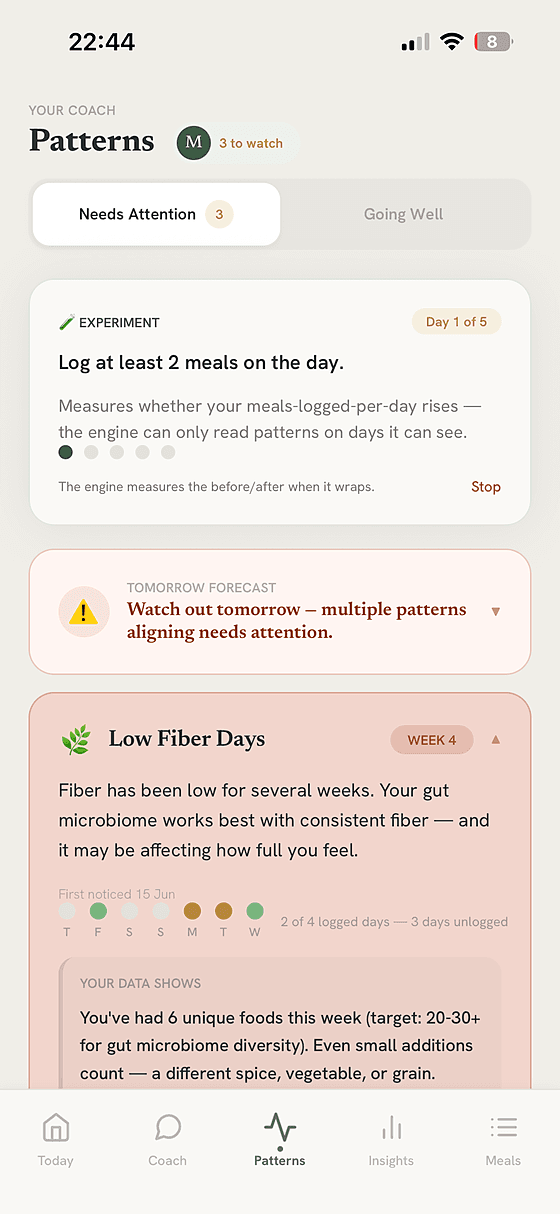
mymir borrows that ambition — a coach, not a database — but builds the coaching from your actual data instead of a fixed lesson plan everyone gets in the same order.
Curriculum vs. your data
Noom's lessons are largely the same for every user on a given day, regardless of what is actually happening in their logs. mymir has no curriculum at all — it watches for patterns specific to you (late-night eating, weekend drift, four straight low-fibre days) and turns whichever one is most relevant right now into a single, concrete action for today. There is no lesson backlog to work through before the app feels useful.
Colour-coded foods vs. no-shame check-ins
Noom's calorie-density colour system works for some people and feels like pressure to others — notably, Noom itself softened the original "red" category to orange after user feedback that a red label made people feel judged about specific foods. mymir sidesteps food-shaming labels entirely and applies the same no-shame principle to logging gaps: if you go quiet for a day, the coach checks in with curiosity, not a streak-broken notification.
| Noom | mymir | |
|---|---|---|
| Pricing (2026) | $17–70/month; best value ~$17.42/mo on 12-month plan | Free tier + Pro; Pro pricing goes live at launch |
| Core mechanism | Daily CBT-style lessons + food colour coding | Personalised pattern detection + 5-day experiments |
| Human coaching | Available as an add-on | AI-driven, no add-on |
| Proof a change worked | Progress tracked, not tested against a baseline | Measured before/after on every experiment |
Where the two approaches actually converge
Both apps agree on the core idea that food apps should do more than count calories — that part of Noom's thesis was right, and it is baked into mymir's design too. The difference is mechanism: Noom teaches behavioural psychology through lessons; mymir runs your own changes as five-day experiments — Observe → Understand → Predict → Recommend → Measure → Learn — and reports back with real before/after numbers, so the proof comes from your data rather than a general principle.
Cost of attention
A daily lesson is a real time commitment, and it is fixed regardless of how much you already know or how busy your week is. mymir's daily ask is smaller by design — one action, chosen because it is the highest-leverage thing in your data right now, not because it is next in a syllabus.
Frequently asked
Related reading
See it for yourself
mymir is live on the App Store. Free to download, free to start — see what it notices in your first week.
Download on the App Store →